
Five of the Rarest Coins in the World & Their Record Prices

Five of the Rarest Coins in the World & Their Record Prices

Every collector dreams of owning an extraordinarily rare coin — the kind that trades for millions and carries a story to match. Few ever will, but the history behind the world’s rarest coins is fascinating in its own right. These pieces are prized not for their metal, but for their scarcity, their place in history, and the drama that often surrounds them. Here are five of the rarest coins in the world, and why collectors prize them so highly.


Table of Contents

  1. What Makes a Coin Rare and Valuable?
  2. The 1849 Double Eagle Gold Coin
  3. The 1794 Flowing Hair Silver Dollar
  4. The 1933 Double Eagle Gold Coin
  5. The 1787 Brasher Doubloon
  6. The 2007 Big Maple Leaf Gold Coin
  7. Final Thoughts
  8. Sources

What Makes a Coin Rare and Valuable?

Before diving into the list, it helps to understand why these coins command such staggering prices. Rarity, historical significance, condition, and provenance all combine to push a coin’s value far beyond its face value or metal content. A coin that survived when nearly all others were melted, or that marked a “first” in a nation’s history, becomes almost irreplaceable — and the market rewards that with record-breaking prices.

The 1849 Double Eagle Gold Coin

In January 1848, James W. Marshall struck gold at John Sutter’s mill in California, igniting the legendary California Gold Rush. Over the next seven years, more than 300,000 hopefuls flooded the region, reshaping the American economy. Among the consequences, Congress authorized new gold coinage — including the “double eagle,” a $20 gold coin struck in 90% gold.

The 1849 Liberty Head Double Eagle, designed by James B. Longacre, features an eagle protected by an American shield beneath the motto “E Pluribus Unum” (“one from many”). The U.S. Mint produced only a single 1849 specimen as a pattern for future double eagles. That one coin now resides in the Smithsonian Institution and is considered essentially priceless, with estimates ranging into the millions — a coin that almost never comes up for sale precisely because only one exists.

The 1794 Flowing Hair Silver Dollar

Designed by Robert Scot, the Flowing Hair dollar was the very first dollar coin issued by the U.S. federal government, struck in 1794. Its size and weight were modeled on the widely trusted Spanish dollar. Minted in 90% silver and 10% copper, it featured Lady Liberty on the obverse and an eagle on the reverse, and was produced for only two years before being replaced by the Draped Bust design.

Only about 1,758 were struck, and perhaps 130 to 150 survive today. That scarcity, combined with its status as America’s first silver dollar, makes it one of the most coveted coins in existence. In 2013, a superb specimen graded SP-66 became the first coin ever to break the $10 million mark at auction. It later changed hands in a 2022 private sale for a reported $12 million, cementing its place among the most valuable coins in the world.

The 1933 Double Eagle Gold Coin

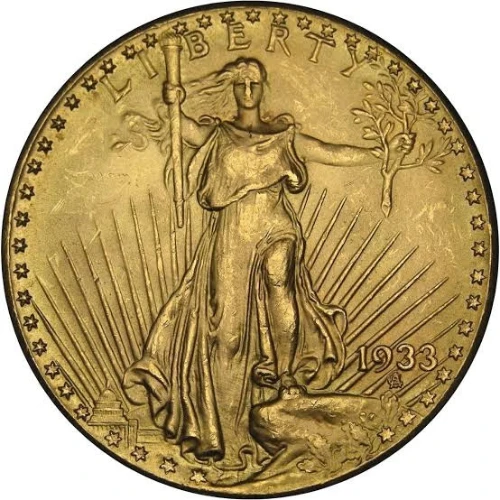
Designed by the sculptor Augustus Saint-Gaudens, the 1933 Double Eagle depicts Lady Liberty striding forward with a torch and an olive branch. Hundreds of thousands were minted, but none were officially released: later in 1933, President Franklin Roosevelt took the country off the gold standard to fight the Great Depression, and in 1934 the Mint ordered all 1933 Double Eagles melted down. It was the last gold coin struck for U.S. circulation.

A handful escaped the melting pot, sparking decades of litigation. One coin — linked to Egypt’s King Farouk — was ultimately declared the only 1933 Double Eagle that can be legally owned by a private individual. Luxury shoe designer Stuart Weitzman bought it in 2002 for $7.59 million, then sold it at a Sotheby’s auction in June 2021 for a record $18.9 million, making it the most expensive coin ever sold at auction.

The 1787 Brasher Doubloon

The 1787 Brasher Doubloon is one of the most important items in American numismatic history — struck years before the federal mint even opened. It was created by New York goldsmith Ephraim Brasher, who made his own gold coins after the state legislature declined his petition for minting rights. Each carries his distinctive “EB” hallmark as a mark of quality, and only a handful are known to exist.

Brasher produced variants distinguished by where the hallmark was placed. The famed “EB on Breast” example sold for $7.4 million in 2011 — then the most ever paid for a U.S. coin. That record was broken in January 2021 when the “EB on Wing” Brasher Doubloon sold at Heritage Auctions for $9.36 million.

The 2007 Big Maple Leaf Gold Coin

The 2007 “Big Maple Leaf,” produced by the Royal Canadian Mint, was at the time the largest coin ever made. Containing 100 kilograms of gold at an extraordinary 99.99% purity, it was the first coin ever to carry a face value of $1 million — though its actual gold value is now several times higher. Only a handful were produced. The obverse shows Queen Elizabeth II, while the reverse bears a stylized maple leaf by RCM engraver Stan Witten.

The coin also has a notorious modern chapter. In March 2017, one Big Maple Leaf — on loan to the Bode Museum in Berlin from a private owner — was stolen in a dramatic heist. It was never recovered, and investigators believe the thieves melted it down, destroying a coin worth millions.

Final Thoughts

These five coins show that rarity is about much more than age or metal. A single surviving pattern, a nation’s first dollar, a coin saved from the melting pot, a goldsmith’s private masterpiece, and a record-breaking modern giant — each earned its place through a unique combination of scarcity and story. For most collectors these coins will only ever be admired from afar, but they represent the pinnacle of what makes numismatics so endlessly compelling.

Sources

Our Latest Articles

  • Loading articles...

CATEGORIES

  • Loading...

Recent Posts

Loading...

Recent Comments

No comments to show.

ALL CATEGORIES

  • Loading...